The Styrofoam loads are common. Every expat has a photo. The ice load is unusual. That guy was really struggling.
John & Sun-Ling are winding down in Shanghai after a two-year tenure and are planning for a 5-month adventure in southern China and northern SE Asia. Go to http://meckleyearth.blogspot.com for our upcoming travels.
Showing posts with label transportation. Show all posts
Sunday, December 02, 2007
Loaded
Three-wheeled bicycles are used to haul anything and everything in China. In the past month we've seen a few real loads.
The Styrofoam loads are common. Every expat has a photo. The ice load is unusual. That guy was really struggling.


The Styrofoam loads are common. Every expat has a photo. The ice load is unusual. That guy was really struggling.
Labels:
bicycle,
china,
shanghai,
transportation
Saturday, September 08, 2007
We go to a wedding OR John gives a speech
Last weekend we attended a wedding in Nantong, China, a medium-size city on the north bank of the Yangtze River, about 3 hours from Shanghai. One of my team members, Wang Ning, was getting married and she invited me to be the ZhengHunRen or "Master Witness". More about that later.
The wedding was Saturday at 6PM and early that afternoon the car that Wang Ning arranged for us arrived at 1:00 PM. The driver was one of those "professional" drivers who makes every maneuver possible to gain advantage including driving on the wrong side of the road. ;-)
We made good time and arrived at the Yangtze River Ferry at 3PM. The major cities of the Yangtze river delta - Shanghai, Nanjing, Hangzhou, Suzhou, Ningbo, and Wuxi - are south of the river. Nantong is to the north and is not as well known although she claims to be "the first modern city in China". More later.
There is a new bridge across the Yangtze just south-east of Nantong that will open next April, but for now we have to ride the ferry. The driver knew exactly how to work the system to beat the long lines and we wound up waiting for only 10 minutes instead of hours. Literally he just drove directly to the front of the line.
These ferries were similar, maybe identical, to the ones we rode this spring to cross the Yangtze at Zhenjiang. It was raining so I did not get out of the car to take photos.
We got to Nantong about 4:10. Wang Ning and soon-to-be-husband Shen Tao were waiting to greet us at the Youfei Hotel, the only 5-star hotel in Nantong. The bride and groom escorted us to our room. This was our first chance to meet the groom, an entrepreneur from Nantong, and he seemed like a really good guy.
Room 616 in tower B was excellent. We took a nice short nap before dressing and heading downstairs at 6PM for the wedding.
Sandy, who had ridden with us from Shanghai, was the sign-in lady. We signed in and had our photo taken with the bride and groom. We also had a brief chance to meet both sets of parents who were very cordial.
The Chinese pre-wedding rituals are distinctly different from those in the US. In the US, the bride and groom do not see each other the day of the wedding and the "photo taking" and "receiving line" occur between the ceremony and the reception (while I'm usually starving). ;-)
In China, the bride and groom and their families greet the guests as they arrive, photos are taken with each guest, and gifts (red packets) are received. I like it.
The wedding was on the 3rd floor in a very luxurious banquet room with 28 X 10-person tables. We were seated in the 2nd row of tables. The decorations were fabulous - lots of white flowers. See the photos.
The wedding banquet started on time at 6:48 (according to Sandy). The bride and groom walked down the aisle to the stage amid some very loud welcomes by the M.C. yes, the MC. No minister as this is the wedding ceremony not official civil marriage.
Next, I was introduced as the ZhengHunRen and I walked up to the stage with spotlights blazing, and gave my speech - in Chinese. Basically the ZhengHunRen, or Master Witness, is a respected family member, friend, work colleague, or former teacher who gives a short 3-part speech: a welcome, a few kind words about the bride and groom, and a concluding "may you be united forever, in sickness and health, etc, etc".
I was happy to get my speech over with early as I had been practicing it in Chinese for a week and was of course nervous. Much thanks to Sun-Ling and my colleagues at work for their help and encouragement.
The wedding then proceeded with all the usual bits. The tower of champagne glasses, candle lighting, toasting, exchanging of rings, eating, etc. There was a new twist that I had not seen before at a Chinese wedding - a band performed about 5 songs while we were eating.
The food was excellent and the red wine was tasty. We toasted the bride and groom, the bride's parents, the groom's parents, and finally the bride and groom again before the wedding wound down around 9PM.
We went back up to our room were I ditched my coat and tie and we headed out for stroll. The rain had stopped and we were treated to the first comfortable evening of the summer. Nantong has many canals and bridges. We made a short circuit, and on the way saw a magnificent art deco building from the early 1950's. A real gem. Awesome.
Crashed around 10:30.
Slept in a bit on Sunday. Had a very good breakfast at the hotel and then Wang Ning's parents picked us up for a short tour around Nantong. First stop: a daylight photo op at the art deco building. Second: the home of Zhang Jian (1853 - 1926), nicknamed the “King of Nantong” who started the Nantong Institute of Technology, the first textile college in China, and founded the first private museum in China. Thus the city tag line of "the first modern city in China".
Then to the nearby Wang family home. A neat old style compound. We drank tea and chatted with grandmother Wang who is the only family member living there now.
Then a brief visit to the nearby Tianning Buddhist temple - very cool. Took lots of photos.
Then over to the apartment of the newlyweds - big and new - before heading off to lunch. Finished lunch around 2PM, went back to hotel, packed, and checked out. The driver had us back at our apartment at 5:30.
It was not raining so I took a ton of photos on the ferry.
Some photos are below. To see all the photos click here.
The bride and groom greet guests and take photos.

The banquet room. Check out the photos on the back wall of the bride and groom.

John gives a speech

The view from the Hotel of downtown Nantong.

The People's Palace.

Tianning Temple

The view from the ferry
The wedding was Saturday at 6PM and early that afternoon the car that Wang Ning arranged for us arrived at 1:00 PM. The driver was one of those "professional" drivers who makes every maneuver possible to gain advantage including driving on the wrong side of the road. ;-)
We made good time and arrived at the Yangtze River Ferry at 3PM. The major cities of the Yangtze river delta - Shanghai, Nanjing, Hangzhou, Suzhou, Ningbo, and Wuxi - are south of the river. Nantong is to the north and is not as well known although she claims to be "the first modern city in China". More later.
There is a new bridge across the Yangtze just south-east of Nantong that will open next April, but for now we have to ride the ferry. The driver knew exactly how to work the system to beat the long lines and we wound up waiting for only 10 minutes instead of hours. Literally he just drove directly to the front of the line.
These ferries were similar, maybe identical, to the ones we rode this spring to cross the Yangtze at Zhenjiang. It was raining so I did not get out of the car to take photos.
We got to Nantong about 4:10. Wang Ning and soon-to-be-husband Shen Tao were waiting to greet us at the Youfei Hotel, the only 5-star hotel in Nantong. The bride and groom escorted us to our room. This was our first chance to meet the groom, an entrepreneur from Nantong, and he seemed like a really good guy.
Room 616 in tower B was excellent. We took a nice short nap before dressing and heading downstairs at 6PM for the wedding.
Sandy, who had ridden with us from Shanghai, was the sign-in lady. We signed in and had our photo taken with the bride and groom. We also had a brief chance to meet both sets of parents who were very cordial.
The Chinese pre-wedding rituals are distinctly different from those in the US. In the US, the bride and groom do not see each other the day of the wedding and the "photo taking" and "receiving line" occur between the ceremony and the reception (while I'm usually starving). ;-)
In China, the bride and groom and their families greet the guests as they arrive, photos are taken with each guest, and gifts (red packets) are received. I like it.
The wedding was on the 3rd floor in a very luxurious banquet room with 28 X 10-person tables. We were seated in the 2nd row of tables. The decorations were fabulous - lots of white flowers. See the photos.
The wedding banquet started on time at 6:48 (according to Sandy). The bride and groom walked down the aisle to the stage amid some very loud welcomes by the M.C. yes, the MC. No minister as this is the wedding ceremony not official civil marriage.
Next, I was introduced as the ZhengHunRen and I walked up to the stage with spotlights blazing, and gave my speech - in Chinese. Basically the ZhengHunRen, or Master Witness, is a respected family member, friend, work colleague, or former teacher who gives a short 3-part speech: a welcome, a few kind words about the bride and groom, and a concluding "may you be united forever, in sickness and health, etc, etc".
I was happy to get my speech over with early as I had been practicing it in Chinese for a week and was of course nervous. Much thanks to Sun-Ling and my colleagues at work for their help and encouragement.
The wedding then proceeded with all the usual bits. The tower of champagne glasses, candle lighting, toasting, exchanging of rings, eating, etc. There was a new twist that I had not seen before at a Chinese wedding - a band performed about 5 songs while we were eating.
The food was excellent and the red wine was tasty. We toasted the bride and groom, the bride's parents, the groom's parents, and finally the bride and groom again before the wedding wound down around 9PM.
We went back up to our room were I ditched my coat and tie and we headed out for stroll. The rain had stopped and we were treated to the first comfortable evening of the summer. Nantong has many canals and bridges. We made a short circuit, and on the way saw a magnificent art deco building from the early 1950's. A real gem. Awesome.
Crashed around 10:30.
Slept in a bit on Sunday. Had a very good breakfast at the hotel and then Wang Ning's parents picked us up for a short tour around Nantong. First stop: a daylight photo op at the art deco building. Second: the home of Zhang Jian (1853 - 1926), nicknamed the “King of Nantong” who started the Nantong Institute of Technology, the first textile college in China, and founded the first private museum in China. Thus the city tag line of "the first modern city in China".
Then to the nearby Wang family home. A neat old style compound. We drank tea and chatted with grandmother Wang who is the only family member living there now.
Then a brief visit to the nearby Tianning Buddhist temple - very cool. Took lots of photos.
Then over to the apartment of the newlyweds - big and new - before heading off to lunch. Finished lunch around 2PM, went back to hotel, packed, and checked out. The driver had us back at our apartment at 5:30.
It was not raining so I took a ton of photos on the ferry.
Some photos are below. To see all the photos click here.
The bride and groom greet guests and take photos.
The banquet room. Check out the photos on the back wall of the bride and groom.
John gives a speech
The view from the Hotel of downtown Nantong.
The People's Palace.
Tianning Temple
The view from the ferry
Tuesday, July 31, 2007
Gridlock (updated)
UPDATE: August 09, 2007
In a recent email to a friend in Shanghai, I coined a the new phrase "driver induced gridlock" to describe the type of gridlock caused solely by impatient, ignorant drivers as opposed to gridlock caused by too much traffic, accidents, bad weather, etc.
----------------------------------------
Original Post: July 31, 2007
Traffic congestion in Shanghai is usually not too bad. Many people use public transportation (ferry, bus, subway, and light rail), bike, take taxis, or walk. But during rush hour the subway is packed, buses are crowded, traffic moves slowly and empty taxis are few.
One of the busiest intersections in Shanghai - Nandan Lu and Caixi Bei Lu - is just below our apartment window. It has loads of pedestrian, bus, motorbike, bicycle, and bus traffic due to it's proximity to a major metro station, a major business and shopping district, a sports stadium complex, and a major north-south expressway.
It is amazing to peer from our window and watch the action - the flow of humans and machines. However, last Saturday night, the flow became a trickle. Gridlock. Even though there was no accident, no construction, and the traffic lights were working, the flow came to a momentary stop.
Here's a photo.

After about 10 minutes the grid became unlocked.
In a recent email to a friend in Shanghai, I coined a the new phrase "driver induced gridlock" to describe the type of gridlock caused solely by impatient, ignorant drivers as opposed to gridlock caused by too much traffic, accidents, bad weather, etc.
----------------------------------------
Original Post: July 31, 2007
Traffic congestion in Shanghai is usually not too bad. Many people use public transportation (ferry, bus, subway, and light rail), bike, take taxis, or walk. But during rush hour the subway is packed, buses are crowded, traffic moves slowly and empty taxis are few.
One of the busiest intersections in Shanghai - Nandan Lu and Caixi Bei Lu - is just below our apartment window. It has loads of pedestrian, bus, motorbike, bicycle, and bus traffic due to it's proximity to a major metro station, a major business and shopping district, a sports stadium complex, and a major north-south expressway.
It is amazing to peer from our window and watch the action - the flow of humans and machines. However, last Saturday night, the flow became a trickle. Gridlock. Even though there was no accident, no construction, and the traffic lights were working, the flow came to a momentary stop.
Here's a photo.
After about 10 minutes the grid became unlocked.
Labels:
gridlock,
shanghai,
traffic,
transportation,
xujiahui
Saturday, July 28, 2007
Huang Yu
The 3-wheeled bicycle plus driver is the real workhorse of China. They carry anything, anyone,anywhere, anytime. Their common name in Shanghai is huang yu ("yellow fish" or "croaker") as in the past these wagons were mainly used to transport fish. Northerners have a different name.
Last night we saw a huang yu moving an incredibly large load - probably Styrofoam - and Sun-Ling spotted it just in time for me to shoot this video (I apologize in advance for the overly long credits. Sometimes I just can't help myself with Windows Movie Maker).
Here are a few other shots of 3-wheelers in action.


Last night we saw a huang yu moving an incredibly large load - probably Styrofoam - and Sun-Ling spotted it just in time for me to shoot this video (I apologize in advance for the overly long credits. Sometimes I just can't help myself with Windows Movie Maker).
Here are a few other shots of 3-wheelers in action.
Wednesday, July 04, 2007
Road Rage
One day last week on the way home from work, the shuttle bus came to a stop on Humin Elevated Expressway and I woke me from my nap just in time to see a guy running down the middle of the highway. He stopped about 50 meters in front of the bus and started arguing with the driver of a minivan. I quickly pulled out my mobile phone and snapped this photo as we drove by. They are not dancing. ;-)
Friday, June 29, 2007
In Flight
A few weeks ago we flew to Shenyang on Spring Airlines, a low-fare carrier based in Shanghai. They really are a budget airline. You get a free bottle of water, but must pay for all other snacks, food, and beverages. All seats are economy class and the leg room is pretty tight. There are no magazines in the "seat pocket in front of you" and there is no in flight entertainment... Well that's not exactly true. Watch this video I shot.
Monday, June 18, 2007
Riding the Ferry from Zhenjiang to Guazhou (and back)
A few weeks ago, Sun-Ling and I made a weekend trip to Zhenjiang, China.
Zhenjiang, an ancient town, is located about 100 miles west of Shanghai at the confluence of the Yangtze River and the Grand Canal. It is mentioned by Marco Polo as the place he landed after crossing the Yangtze on the way to Hangzhou. I did not verify this from the original source but it’s mentioned in all the Zhenjiang travel websites so it must be true. ;-)
One cannot exactly retrace the Yangtze crossing of Polo from Guazhou on the north bank to Zhenjinag on the south but you take the modern ferry from the outskirts of Guazhou (a very small town even by Chinese standards) to the outskirts of Zhenjiang. The cost is 3 RMB each way and you get to walk on the ferry along side the cars, taxis, buses, tractors, and bicycles. Bus #110 takes you from the Zhenjiang train station right to the ferry landing in about 30 minutes. The ride itself is fantastic, about 15 minutes long, you can basically go anywhere on the ferry, and there is lots river traffic to watch.
There appeared to be 4 ferries operating the day we were there with almost no waiting time between departures. Strange to me as there is a massive, newly completed bridge just a few hundred meters downstream. The talkative ticket taker told us that the ferry is kept open/running for military reasons and that it’s cheaper than the toll on the bridge.
Once on the Guazhou side, it’s a 10 to 20 minutes walk along the Yangtze River levee to Guazhou town and the Ancient Ferry Scenic Park or you can hire a minivan or taxi. The fare is anywhere between 2 to 10 RMB per person depending on your negotiating skills. We walked. See photos. We had to ask directions several times. See video.
The Ancient Ferry landing at Guazhou is now a park, admission 8 RMB (about 1 USD), where one can see the old landing (a bunch of rocks and concrete) and the newer, operational, canal locks. The park is not well maintained.
We did not have time to find the old ferry landing on the Zhenjiang side but the guide books say it exists.
Here are some photos and some video of the ferry excursion.
Boarding the ferry at Guazhou. We are boarding the one at left. The one at right has almost arrived. Check out the tractor.

Riding the ferry. You can see the new bridge in the background.

Walking to Guazhou along the levee that protects the town from the Yangtze (river to the right).

Video of Sun-Ling asking directions in Guazhou Town.
The site of the ancient ferry landing at Guazhou.

Locks on the Grand Canal - part of the Ancient Ferry Scenic Area.

The one on the left is loading, the one I'm on has just pulled out.

Video of the ferries in action.
Zhenjiang, an ancient town, is located about 100 miles west of Shanghai at the confluence of the Yangtze River and the Grand Canal. It is mentioned by Marco Polo as the place he landed after crossing the Yangtze on the way to Hangzhou. I did not verify this from the original source but it’s mentioned in all the Zhenjiang travel websites so it must be true. ;-)
One cannot exactly retrace the Yangtze crossing of Polo from Guazhou on the north bank to Zhenjinag on the south but you take the modern ferry from the outskirts of Guazhou (a very small town even by Chinese standards) to the outskirts of Zhenjiang. The cost is 3 RMB each way and you get to walk on the ferry along side the cars, taxis, buses, tractors, and bicycles. Bus #110 takes you from the Zhenjiang train station right to the ferry landing in about 30 minutes. The ride itself is fantastic, about 15 minutes long, you can basically go anywhere on the ferry, and there is lots river traffic to watch.
There appeared to be 4 ferries operating the day we were there with almost no waiting time between departures. Strange to me as there is a massive, newly completed bridge just a few hundred meters downstream. The talkative ticket taker told us that the ferry is kept open/running for military reasons and that it’s cheaper than the toll on the bridge.
Once on the Guazhou side, it’s a 10 to 20 minutes walk along the Yangtze River levee to Guazhou town and the Ancient Ferry Scenic Park or you can hire a minivan or taxi. The fare is anywhere between 2 to 10 RMB per person depending on your negotiating skills. We walked. See photos. We had to ask directions several times. See video.
The Ancient Ferry landing at Guazhou is now a park, admission 8 RMB (about 1 USD), where one can see the old landing (a bunch of rocks and concrete) and the newer, operational, canal locks. The park is not well maintained.
We did not have time to find the old ferry landing on the Zhenjiang side but the guide books say it exists.
Here are some photos and some video of the ferry excursion.
Boarding the ferry at Guazhou. We are boarding the one at left. The one at right has almost arrived. Check out the tractor.
Riding the ferry. You can see the new bridge in the background.
Walking to Guazhou along the levee that protects the town from the Yangtze (river to the right).
Video of Sun-Ling asking directions in Guazhou Town.
The site of the ancient ferry landing at Guazhou.
Locks on the Grand Canal - part of the Ancient Ferry Scenic Area.
The one on the left is loading, the one I'm on has just pulled out.
Video of the ferries in action.
Labels:
ferry,
guazhou,
jiangsu,
transportation,
zhenjiang
Sunday, June 03, 2007
Riding the Bullet Train to Zhenjiang
China Railways has recently introduced new "bullet trains" on several routes in and out of Shanghai. The trains are called CRH in English, short for China Railway High-Speed, and Hexie Hao "The Harmonious" in Chinese.
I took some photos earlier this year of the CRH's rolling by the Lianhua Lu Metro Station on their way to Hangzhou. Last weekend we finally got to ride one as we spent the weekend in Zhenjiang, China - a city on the Yangtze River, east of Nanjing.
I left work early and we arrived at Shanghai Station just after 5PM. We tried to enter the station via the usual Soft Seat Waiting Room but were politely told we must enter through the CRH entrance. Duh. How did we miss those blue CRH signs?
Avoiding the scuffle at the ticket entrance (a guy and his girl friend tried to enter without tickets) we headed down to platform 13 where the sleek (you might say virile) new CRH was boarding for the 17:30 trip to Nanjing - the D442. Great! And to my delight, just across the platform another CRH was waiting - the 17:35 to Nanjing (D444). I handed the luggage to Sun-Ling and took a few photos before getting on the train.
Unlike the Japanese Shinkansen, this train does not travel on specially built tracks. It uses the regular "electric-overhead" tracks and the highest speed we noted on the car-end ticker was 205 km.
Looking at the photos, you see a "nose cap" on the locomotive. That's because the normal 8-car trains can be coupled together, nose-to-nose, to make a 16-car train. You can see this in the video. The train to Zhenjiang was 8-car, the return 16.
With a 3 X 2 seat configuration, tray tables, seat-back "car-layout" diagrams, smart attendant's uniforms, men's standing toilets, and 100 percent non-smoking cars, the CRH is reminiscent of the Shinkansen. However you will find no "silence car", bowing conductors or polite "cart girls". Both trains we rode were filled with the usual busy and boisterous crowd, with about 10 "standing room" patrons per car, and unflappable attendants.
The cars have differing seat capacities and configurations which don't always agree with the seat-back charts. Car #3 on our return trip had 85 seats - 17 rows.
The rows of seats can be flipped around to face the other way. Wanna see how it's done? Click here.
We were pleasantly surprised to see orderly queues at the Kunshan Station, the first stop. Passengers boarding the train were lined up to enter at the rear of their assigned car, departing passengers left through the front exit. The doors are at platform level which makes entering and exiting quite easy.
We were able to buy the 2 sets of tickets just 5 days in advance from our local Xujiahui branch of China Railways. However, the all the return trains from Zhenjiang were sold out for Sunday night so we bought return tickets from Nanjing, the station of origin even though it cost more.
On Sunday we had a bit of a problem at the Zhenjiang Station. In China, train tickets are not checked by a conductor but are checked as you enter the station/platform and as you board the train. So when we presented our Nanjing to Shanghai tickets to the guy checking the tickets at the CRH entrance to the Zhenjiang Station, he gave them a long hard look. Then he called over his supervisor. She look at them for awhile and then let us through with the caveat that she couldn't guarantee our seats on the train.
Of course we had no trouble claiming our seats once on the train. You can watch us board the train and Sun-Ling boot out the interlopers on this video.
Here are a few more photos from the Shanghai Station.


I took some photos earlier this year of the CRH's rolling by the Lianhua Lu Metro Station on their way to Hangzhou. Last weekend we finally got to ride one as we spent the weekend in Zhenjiang, China - a city on the Yangtze River, east of Nanjing.
I left work early and we arrived at Shanghai Station just after 5PM. We tried to enter the station via the usual Soft Seat Waiting Room but were politely told we must enter through the CRH entrance. Duh. How did we miss those blue CRH signs?
Avoiding the scuffle at the ticket entrance (a guy and his girl friend tried to enter without tickets) we headed down to platform 13 where the sleek (you might say virile) new CRH was boarding for the 17:30 trip to Nanjing - the D442. Great! And to my delight, just across the platform another CRH was waiting - the 17:35 to Nanjing (D444). I handed the luggage to Sun-Ling and took a few photos before getting on the train.
Unlike the Japanese Shinkansen, this train does not travel on specially built tracks. It uses the regular "electric-overhead" tracks and the highest speed we noted on the car-end ticker was 205 km.
Looking at the photos, you see a "nose cap" on the locomotive. That's because the normal 8-car trains can be coupled together, nose-to-nose, to make a 16-car train. You can see this in the video. The train to Zhenjiang was 8-car, the return 16.
With a 3 X 2 seat configuration, tray tables, seat-back "car-layout" diagrams, smart attendant's uniforms, men's standing toilets, and 100 percent non-smoking cars, the CRH is reminiscent of the Shinkansen. However you will find no "silence car", bowing conductors or polite "cart girls". Both trains we rode were filled with the usual busy and boisterous crowd, with about 10 "standing room" patrons per car, and unflappable attendants.
The cars have differing seat capacities and configurations which don't always agree with the seat-back charts. Car #3 on our return trip had 85 seats - 17 rows.
The rows of seats can be flipped around to face the other way. Wanna see how it's done? Click here.
We were pleasantly surprised to see orderly queues at the Kunshan Station, the first stop. Passengers boarding the train were lined up to enter at the rear of their assigned car, departing passengers left through the front exit. The doors are at platform level which makes entering and exiting quite easy.
We were able to buy the 2 sets of tickets just 5 days in advance from our local Xujiahui branch of China Railways. However, the all the return trains from Zhenjiang were sold out for Sunday night so we bought return tickets from Nanjing, the station of origin even though it cost more.
On Sunday we had a bit of a problem at the Zhenjiang Station. In China, train tickets are not checked by a conductor but are checked as you enter the station/platform and as you board the train. So when we presented our Nanjing to Shanghai tickets to the guy checking the tickets at the CRH entrance to the Zhenjiang Station, he gave them a long hard look. Then he called over his supervisor. She look at them for awhile and then let us through with the caveat that she couldn't guarantee our seats on the train.
Of course we had no trouble claiming our seats once on the train. You can watch us board the train and Sun-Ling boot out the interlopers on this video.
Here are a few more photos from the Shanghai Station.
Sunday, February 04, 2007
A weekend trip to Shaoxing
In November 2006 we made a weekend trip with Sun-Ling's parents to Shaoxing, a town of about 300,000 southwest from Shanghai between Hangzhou and Ningbo. We stayed in a neat hotel, the LaoTaiMen, which used to be the home of some wealthy local.
Sun-Ling and I stayed in the 2nd floor room above the doorway to the left.

Shaoxing is best know as the home of Lu Xun, China's greatest modern writer. In the center of town one can visit the Lu Xun Family Home, the Lu Xun Museum, and the elementary school he attended. We did them all and they were actually quite interesting with good English signage.
Here's a photo of the 4 of us in front of the Lu Xun Museum.

Shaoxing is also famous for is rice wine. We tasted a little bit at dinner Saturday night. Not to my liking. Give me a cold beer!
We visited some of the other sites like Number Eight Bridge, East Lake, and the Mausoleum of Emperor Yu. However, the most interesting thing in Shaoxing in my opinion is that the local boatman row their boats with their feet which you can see in the video below.
Here's a photo in case you didn't watch the video.

We rode the express train both ways. Here's a video of us boarding the train for the return to Shanghai.
Sun-Ling and I stayed in the 2nd floor room above the doorway to the left.
Shaoxing is best know as the home of Lu Xun, China's greatest modern writer. In the center of town one can visit the Lu Xun Family Home, the Lu Xun Museum, and the elementary school he attended. We did them all and they were actually quite interesting with good English signage.
Here's a photo of the 4 of us in front of the Lu Xun Museum.
Shaoxing is also famous for is rice wine. We tasted a little bit at dinner Saturday night. Not to my liking. Give me a cold beer!
We visited some of the other sites like Number Eight Bridge, East Lake, and the Mausoleum of Emperor Yu. However, the most interesting thing in Shaoxing in my opinion is that the local boatman row their boats with their feet which you can see in the video below.
Here's a photo in case you didn't watch the video.
We rode the express train both ways. Here's a video of us boarding the train for the return to Shanghai.
Labels:
boat,
china,
shaoxing,
transportation,
zhejiang
Monday, January 22, 2007
japan videos
Here are all the Japan videos.
Boarding a Bullet Train
Riding the Bullet Train
Okuno-in Monks
Meiji Shrine 360
Kiyomizu Temple - Kyoto
Boarding a Bullet Train
Riding the Bullet Train
Okuno-in Monks
Meiji Shrine 360
Kiyomizu Temple - Kyoto
Labels:
buddhism,
japan,
transportation,
travel
Saturday, April 22, 2006
Metro station photos
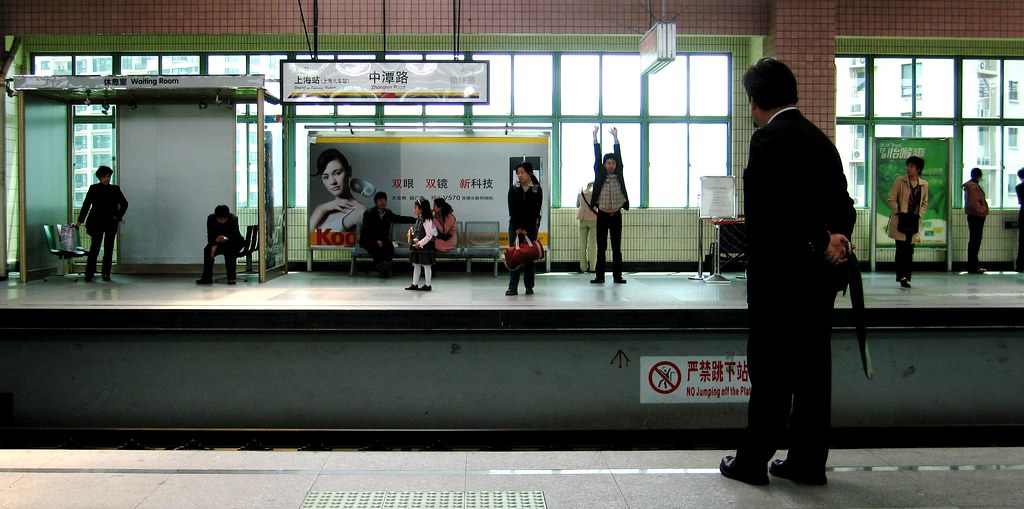
Last weekend, I took some photos at a metro station on Line 3/4 while waiting for our train. There is a story about the first photo. Notice the guy who is stretching (his girlfriend is carry the red bag). Shortly after this photo was taken he somehow dropped his left shoe down onto the tracks. I did not see it happen. However, a few minutes later a guy in a transit uniform walked up with a long pole with a hook on one end and fished up this guy's left shoe. Of course I was too busy watching to pull out my camera during this operation. Bummer.
Waiting for the train. Click here to see a larger version of this photo.

The line 4 (purple line) train.
Waiting for the train. Click here to see a larger version of this photo.
The line 4 (purple line) train.
Sunday, January 15, 2006
A quick word about traffic signs
There is a lot of traffic on the roads of Shanghai – pedestrians, bicycles, scooters, taxis, motorcycles, cars, trucks, buses -- the list goes on.
In order to control the traffic, there are traffic lights almost at every intersection. Red lights effectively stop traffic and green lights effectively start traffic. There is a bit of chaos when the light changes. Like in some European countries, the light flashes red and yellow several times before it turns green. Drag racing anyone? Coming to a complete stop on a red before making a right turn is a recipe for disaster since no one does it. Left turn arrows are usually obeyed. On a road with little traffic, blowing the horn can be a substitute for stopping at a red light.
Lanes are clearly marked and are usually effective at controlling vehicles until there is a backup. Then only curbs and medians can control the flow.
There are two basically two classes of drivers on the road, professional drivers (taxi/bus/chauffeurs) & new drivers (everyone else). There are very helpful street signs for the new drivers.

Stop signs which are ubiquitous in the US are a rare sight here since they would either be ignored, cause accidents if actually obeyed, or necessitate a traffic light. We have caught one so far, along with a rollerblader with a bag of oranges in hand.
In order to control the traffic, there are traffic lights almost at every intersection. Red lights effectively stop traffic and green lights effectively start traffic. There is a bit of chaos when the light changes. Like in some European countries, the light flashes red and yellow several times before it turns green. Drag racing anyone? Coming to a complete stop on a red before making a right turn is a recipe for disaster since no one does it. Left turn arrows are usually obeyed. On a road with little traffic, blowing the horn can be a substitute for stopping at a red light.
Lanes are clearly marked and are usually effective at controlling vehicles until there is a backup. Then only curbs and medians can control the flow.
There are two basically two classes of drivers on the road, professional drivers (taxi/bus/chauffeurs) & new drivers (everyone else). There are very helpful street signs for the new drivers.
Stop signs which are ubiquitous in the US are a rare sight here since they would either be ignored, cause accidents if actually obeyed, or necessitate a traffic light. We have caught one so far, along with a rollerblader with a bag of oranges in hand.
Subscribe to:
Posts (Atom)